












|
|
Jupiter
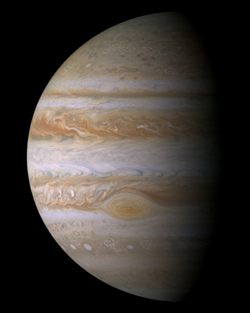 |
Jupiter is a stormy planet. Swirling clouds of gas race
around it, in dark and light bands |
The most massive planet in our
solar system, with four planet-sized moons and many smaller moons,
Jupiter forms a kind of miniature solar system. Jupiter resembles a star
in composition. In fact, if it had been about eighty times more massive,
it would have become a star rather than a planet.
On January 7, 1610, using his primitive telescope, astronomer Galileo
Galilei saw four small 'stars' near Jupiter. He had discovered Jupiter's
four largest moons, now called Io, Europa, Ganymede,
and Callisto.
Collectively, these four moons are known today as the Galilean
satellites.
Galileo would be astonished at what we have learned about Jupiter and
its moons in the past 30 years. Io is the most volcanically active body
in our solar system. Ganymede is the largest planetary moon and is the
only moon in the solar system known to have its own magnetic field. A
liquid ocean may lie beneath the frozen crust of Europa. Icy oceans may
also lie deep beneath the crusts of Callisto and Ganymede. In 2003
alone, astronomers discovered 23 new moons orbiting the giant planet,
giving Jupiter a total moon count of 63 - the most in the solar system.
The numerous small outer moons may be asteroids captured by the giant
planet's gravity.
|
