












|
|
Mars
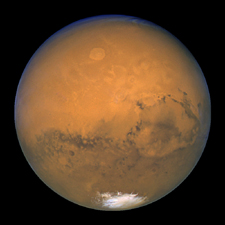 |
Mars
is half the size of Earth. It is covered mainly with rocks and
dust. Most of it looks like a great big desert. It has a thin
atmosphere of poisonous gas. |
The red planet Mars has inspired
wild flights of imagination over the centuries, as well as intense
scientific interest. Whether fancied to be the source of hostile
invaders of Earth, the home of a dying civilization, or a
rough-and-tumble mining colony of the future, Mars provides fertile
ground for science fiction writers, based on seeds planted by centuries
of scientific observations.
We know that Mars is a small rocky body once thought to be very
Earth-like. Like the other "terrestrial" planets - Mercury, Venus and
Earth - its surface has been changed by
volcanism, impacts from other bodies, movements of its crust, and
atmospheric effects such as dust storms. It has polar ice caps that grow
and recede with the change of seasons; areas of layered soils near the
Martian poles suggest that the planet's climate has changed more than
once, perhaps caused by a regular change in the planet's orbit. Martian
tectonism - the formation and change of a planet's crust - differs from
Earth's. Where Earth tectonics involve sliding plates that grind against
each other or spread apart in the seafloors, Martian tectonics seem to
be vertical, with hot lava pushing upwards through the crust to the
surface. Periodically, great dust storms engulf the entire planet. The
effects of these storms are dramatic, including giant dunes, wind
streaks, and wind-carved features.
|
