|
Astronomy |
|
|
||||||
            
|
Mercury
The small and rocky planet Mercury
is the closest planet to the Sun; it speeds around the Sun in a wildly
elliptical (non-circular) orbit that takes it as close as 47 million km
and as far as 70 million km from the Sun. Mercury completes a trip
around the Sun every 88 days, speeding through space at nearly 50 km per
second, faster than any other planet. Because it is so close to the Sun,
temperatures on its surface can reach a scorching 467 degrees Celsius.
But because the planet has hardly any atmosphere to keep it warm,
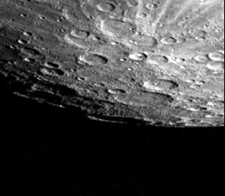
nighttime temperatures can drop to a frigid -183 degrees Celsius. Billions of years ago many rocks crashed into it, so its surface is covered with lots of craters.
|
This site was last updated 08/20/06