












|
|
Saturn
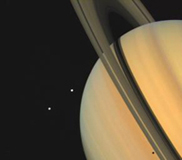 |
Saturn and two of its moons, Tethys (above) and Dione. |
Saturn, the sixth planet from the
Sun, is home to a vast array of intriguing and unique worlds. From the
cloud-shrouded surface of Titan to crater-riddled Phoebe, each of
Saturn's moons tells another piece of the story surrounding the Saturn
system.
Christiaan Huygens discovered the first known moon of Saturn. The year
was 1655 and the moon is Titan. Jean-Dominique Cassini made the next
four discoveries: Iapetus
(1671), Rhea (1672), Dione (1684), and Tethys (1684).
Mimas and
Enceladus were both
discovered by William Herschel in 1789. The next two discoveries came at
intervals of 50 or more years - Hyperion (1848) and Phoebe (1898).
As telescopic resolving power increased through the 19th century,
Saturn's family of known moons grew. In 1966 Epimetheus and Janus were
discovered. By the time Cassini-Huygens was launched in 1997, Saturn's
moon count had reached 18. The number of known moons soon increased with
high-resolution imaging techniques used on ground-based telescopes.
Cassini discovered four more moons after its arrival at Saturn and may
find even more during its mission.
We've discovered a total of 56 natural satellites orbiting Saturn. Each
of Saturn's moons bears a unique story. Two of the moons orbit within
gaps in the main rings. Some, such as Prometheus and Pandora, interact
with ring material, shepherding the ring in its orbit. Some small moons
are trapped in the same orbits as Tethys or Dione. Janus and Epimetheus
occasionally pass close to each other, causing them to periodically
exchange orbits.
|
