












|
|
Venus
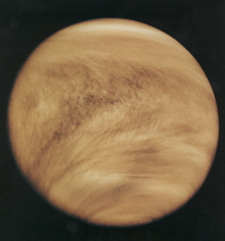 |
Beneath the Venus' perpetual cloud layer, it is a world of
volcanoes, mountains and canyons. |
At first glance, if Earth had a
twin, it would be Venus. The two planets are similar in size, mass,
composition, and distance from the Sun. But there the similarities end.
Venus has no ocean. Venus is covered by thick, rapidly spinning clouds
that trap surface heat, creating a scorched greenhouse-like world with
temperatures hot enough to melt lead and pressure so intense that
standing on Venus would feel like the pressure felt 900 meters deep in
Earth's oceans. These clouds reflect sunlight in addition to trapping
heat. Because Venus reflects so much sunlight, it is usually the
brightest planet in the sky.
The atmosphere consists mainly of carbon dioxide (the same gas that
produces fizzy sodas), droplets of sulfuric acid, and virtually no water
vapor - not a great place for people or plants! In addition, the thick
atmosphere allows the Sun's heat in but does not allow it to escape,
resulting in surface temperatures over 450 °C, hotter than the surface
of the planet Mercury, which is closest to
the Sun. The high density of the atmosphere results in a surface
pressure 90 times that of Earth, which is why probes that have landed on
Venus have only survived several hours before being crushed by the
incredible pressure. In the upper layers, the clouds move faster than
hurricane- force winds on Earth.
Venus sluggishly rotates on its axis once every 243 Earth days, while it
orbits the Sun every 225 days - its day is longer than its year! Besides
that, Venus rotates retrograde, or "backwards," spinning in the opposite
direction of its orbit around the Sun. From its surface, the Sun would
seem to rise in the west and set in the east.
|
