












|
|
Moon
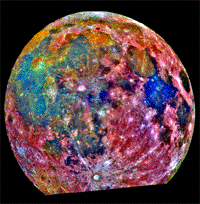 |
This
false-color image shows the Moon's soil and mineral composition.
Mare Tranquillitatis - the 'Sea of Tranquility' - is the dark
blue region on the right. |
The Moon travels around the Earth,
just like the Earth travels around the Sun. So far, the Moon is the only
part of the Solar System that we have been able to visit. More than 70
spacecraft have been sent to the Moon; 12 astronauts have walked upon
its surface and brought back 382 kg (842 pounds) of lunar rock and soil
to Earth. The regular daily
and monthly rhythms of Earth's only natural satellite, the Moon, have
guided timekeepers for thousands of years. Its influence on Earth's
cycles, notably tides, has also been charted by many cultures in many
ages.
The presence of the Moon stabilizes Earth's wobble. This has led to a
much more stable climate over billions of years, which may have affected
the course of the development and growth of life on Earth.
How did the Moon come to be? The leading theory is that a Mars-sized
body once hit Earth and the resulting debris (from both Earth and the
impacting body) accumulated to form the Moon. Scientists believe that
the Moon was formed approximately 4.5 billion years ago (the age of the
oldest collected lunar rocks). When the Moon formed, its outer layers
melted under very high temperatures, forming the lunar crust, probably
from a global "magma ocean."
|
