












|
|
Uranus
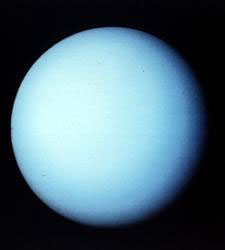 |
Uranus as it would appear to human eyes. |
Once considered one of the
blander-looking planets, Uranus (pronounced YOOR un nus) has been
revealed as a dynamic world with some of the brightest clouds in the
outer solar system and 11 rings. The first planet found with the aid of
a telescope, Uranus was discovered in 1781 by astronomer William
Herschel. The seventh planet from the Sun is so distant that it takes 84
years to complete one orbit. Uranus, with no solid surface, is one of
the gas giant planets (the others are Jupiter, Saturn, and Neptune).
The atmosphere of Uranus is composed primarily of hydrogen and helium,
with a small amount of methane and traces of water and ammonia. Uranus
gets its blue-green color from methane gas. Sunlight is reflected from
Uranus' cloud tops, which lie beneath a layer of methane gas. As the
reflected sunlight passes back through this layer, the methane gas
absorbs the red portion of the light, allowing the blue portion to pass
through, resulting in the blue-green color that we see. The planet's
atmospheric details are very difficult to see in visible light. The bulk
(80 per-cent or more) of the mass of Uranus is contained in an extended
liquid core consisting primarily of 'icy' materials (water, methane, and
ammonia), with higher-density material at depth.
|
